Contents
Sanabi’s (@0xSanabi) post is about moving beyond one-off questions in Claude Code to a system where multiple agents work, check results, and move on. The first thing to emulate is a small loop with conditions for execution, verification, and stopping—not a 50-agent setup.
Key Points#
- Sanabi promotes a workshop introducing a harness that runs more than 50 Claude agents.
- The post centers on the progression “model → tools → harness → closed loop → self-improving system.”
- According to research cited in the post, a review of 36,487 repositories found that loops often have triggers but lack verification, state, and exit conditions.
- A practical starting point is to try about two agents with separate roles, then measure quality and cost before adding more.
Reading the Post’s Claims#
Sanabi’s post attributes this claim to an Anthropic engineer: “99% use Opus 5.5 like Google, while the top 1% build harnesses that run multiple agents.” It also describes a setup overseen by a Chief or PM agent and promotes a 26-minute workshop.
These percentages and phrases such as “maximum results at minimum cost” are best read as promotional claims in the post. The information here alone does not establish how those percentages were calculated or how effective the workshop is. What matters is less the size of the numbers than the idea of designing tools and execution rules, rather than stopping at instructions to a model.
A Harness Provides a Framework for Work#
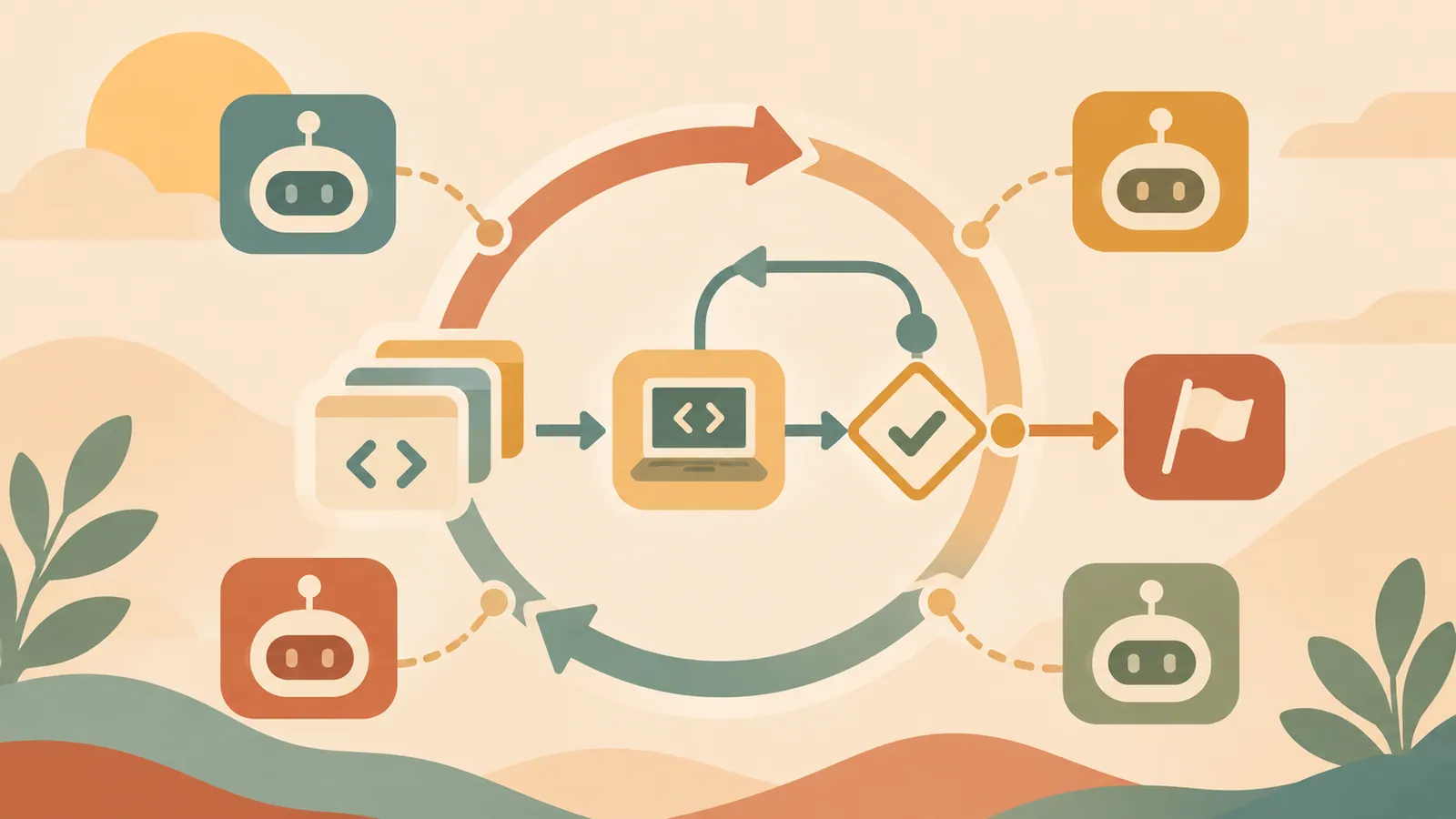
A harness is an execution environment that brings together the tasks assigned to agents, available tools, shared state, and criteria for judging results. With separate roles, for example, one agent changes code while another reviews the diff to check whether it meets the requirements. A Chief or PM agent breaks down requests and assigns the work.
Adding agents does not automatically make things faster, though. If work overlaps or agents change the same file simultaneously, coordination takes more effort. Start with two roles—one making changes and one checking them—and specify who owns each task.
Give the Loop an Exit#
The research cited in the post is titled “Harness, Loops, Graphs: What 217 Real Agent Loops Are Missing.” According to the post’s summary, it examined 36,487 repositories and found that loops had triggers but lacked verification, state, and exit conditions. This is the post’s account of the research; the original article needs to be consulted for details of the methodology.
When implementing a loop, decide not only what starts it, but also how to judge results, what to do on failure, and when to stop. For example, a rule such as “If tests fail, retry the fix once; if they still fail, hand it back to a person” can reduce the risk of endless retries.
Start Small and Measure#
For the first experiment, limit the scope to one small task. Define the input, completion criteria, and attempt limit before running the worker agent and reviewer. For code changes, restricting the target files and permitted commands also makes results easier to track.
Four metrics are enough for comparison: completion rate, issues found during review, time per task, and cost per task. Compare these with results from a single agent as well. If costs and review effort increase while completion rates stay the same, there is little reason to add agents.
Self-Improvement Starts with Records#
The phrase “self-improving system” may bring to mind agents rewriting their own setup. But there is no need to let them make automatic changes from the outset. Simply recording failed instructions, revision counts, and issues found during review—and having a person decide what to change for the next run—provides material for improvement.
If you move on to automatically updating prompts or settings, record the changes and make it possible to restore previous settings. An apparent improvement can make performance worse on other types of tasks. Keep evaluation tasks fixed and compare results under the same conditions before and after each change.
The Next Step#
Choose one small task and try it with “one worker agent, one reviewer, one retry, and a stop on failure,” then compare its time, cost, and number of issues with a single-agent run.
Source: https://x.com/0xSanabi/status/2118412839081988342
Contents