Contents
DuckDB 2.0 LTS introduces client/server connections through Quack, asynchronous I/O for remote reads, and a native VARIANT type for semi-structured data. The release, codenamed "Cinnamon Teal," also brings an extensible SQL parser and comes with a stated support window that runs until at least October 2027.
Key Points#
- Quack lets multiple DuckDB clients connect to a DuckDB instance running on another machine.
- Asynchronous I/O increases concurrency for remote reads, but how much it helps depends on the workload and the storage service.
- VARIANT stores semi-structured data in a format designed for efficient compression and query processing.
- This LTS release adds triggers and parser extensions, but existing applications should be checked for compatibility before upgrading.
Quack Enables Shared Access#
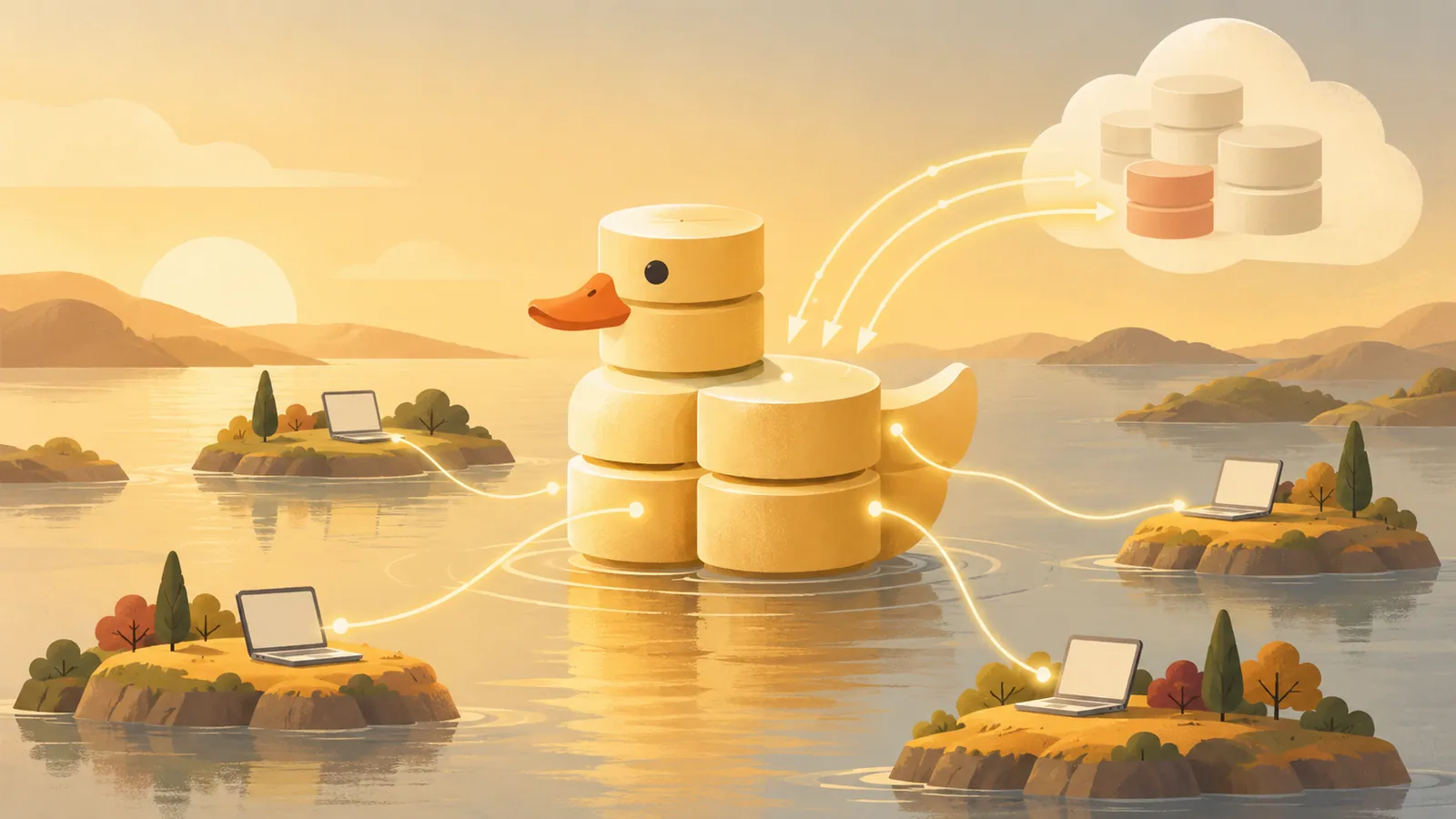
Quack gives DuckDB a client/server option. A local DuckDB client can connect to a remote DuckDB instance, and the server can accept connections from multiple clients.
This makes it easier to share an analytical database without managing a local copy for every user. A team can keep a working dataset on a single machine and access it from several analysis environments. Embedded and local use remain as useful as ever; running as a server is simply a new way to run DuckDB.
A shared endpoint also brings operational questions. Before deploying, check the documentation for authentication, encryption, connection limits, and behavior under concurrent access. The announcement material available here describes server connections but does not cover these details. Client/server support alone is no evidence that a deployment meets your security or availability requirements.
Asynchronous I/O Targets Remote Reads#
With asynchronous processing, DuckDB 2.0 separates query processing from I/O more effectively. The goal is higher read concurrency, especially when files live in remote object storage such as Amazon S3.
Workloads that spend much of their time waiting on remote data can keep more requests in flight while query processing continues, which cuts down on waiting. Queries dominated by local computation may see little benefit.
The available material includes no reproducible benchmarks or measured speedups, so treat any performance or cost improvements as claims to verify. Compare the old and new versions using the same dataset, queries, machine configuration, and storage region. Record elapsed time and peak memory usage, and check storage request counts and charges separately. A faster query is not necessarily a cheaper one.
VARIANT Handles Shifting Data#
The new VARIANT type targets semi-structured records whose fields and value types vary. According to the announcement, it detects common structure in the data and uses it to store and query that data efficiently.
That makes it worth evaluating for event records with inconsistent fields or for imported documents. How useful it turns out to be in practice depends on the shape of your data and which fields your queries read.
Try it on a representative sample before converting a production dataset. Compare it with your current representation on storage size, ingestion time, query results, and query execution time. Include missing fields, explicit nulls, nested values, and mixed types in the sample. Cases like these can surface compatibility issues that uniform test data would miss.
SQL Extensions and Triggers#
DuckDB 2.0 replaces the old parser with one based on Parsing Expression Grammar (PEG). The release describes support for statements, clauses, and keywords defined by extensions, giving extension developers more room to add SQL syntax.
For application teams, the immediate concern is compatibility. Run your existing SQL on the new version, especially queries that are auto-generated or depend on extensions. Parsing checks syntax and builds an internal representation of each statement; resolving table names and checking types happen at separate stages of query processing.
The source report also lists triggers, which run predefined actions when data changes. One example use is recording changes in an audit table. Before relying on triggers for audit completeness or data integrity, check which events they support, how they behave within transactions, and what their limitations are.
Planning the Upgrade to LTS#
The stated support period runs until at least October 2027. That gives teams a reference point for maintenance planning, but even an LTS release needs testing before a major upgrade.
Use a copy of an existing database for your first migration trial. Check database file compatibility, extension availability, and application driver support against the official migration guide. Make sure you have a restorable backup before opening production files with the new version.
Keep upgrade validation separate from adopting new features. First confirm that existing queries return the expected results with acceptable performance. Then test Quack, asynchronous reads, and VARIANT one at a time, so that if something goes wrong you can pinpoint the cause.
Next Steps#
Before setting an upgrade date, run your most important analytical queries on DuckDB 2.0 LTS against a copy of your dataset, and compare the results and execution times with your current version.
Source: https://www.publickey1.jp/blog/26/duckdb_20_ltsquack.html
Contents